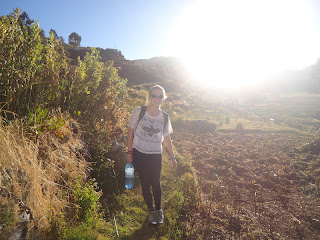
My second day in Samaipata I went on a trek with a French couple and a German. We went into Amboro National Park to the Cloud Forest. Of course, the day that we went was only the second or third clear day of the year so the Cloud Forest wasn't too cloudy. Although we didn't get to see all the beautiful mist that usually surrounds the trees we did get an amazing panoramic view. A fair trade.
The Cloud Forest is home to the helechos gigantes– the giant ferns. These are prehistoric flora that grow only one centimeter per year. Their slow growth rate is due to their age– they were around before the dinosaurs so didn't have to grow quickly because no animals were eating them. When the dinosaurs did show up some plants adapted by growing quickly– but the giant ferns adapted by secreting poison. So the dinosaurs didn't dare eat them and in present day neither do any other animals. Some of the ferns are about seven meters tall, which makes them thousands of years old! When they do die and fall over, the head of the fern starts to grow again– so in a sense they never die. Besides the giant ferns, the flora in the Cloud Forest was quite amazing. I felt like I was on the movie set for Jurassic Park because everything was just so big and green– I have never been in a forest like this before. There are pumas, bears, jaguars, and tree snakes that are up to two meters long in Amboro National Park– but I didn't see any of these animals (un)fortunately.
Friday, June 15, 2012
Wednesday, June 13, 2012
Samaipata & El Fuerte
| Saimapata's views were great– a nice change of pace from dry, dusty, red Sucre! |
I have a talent for choosing the sketchiest bus companies. I honestly don't know how I do it– but I never end up on a tourist bus. And I don't always necessarily buy the cheapest ticket, I just believe the vendors when they tell me the bus is nice. Stupid, stupid, stupid. Friday night I had a loooong bus ride to Samaipata, like 12 hours long. And the bus was well, it was riding the struggle bus. I am surprised it didn't break down. Twelve hours on a wheezing bus. But I wish it was longer since I arrived in Samaipata at 4:30 in the morning. And when I say I arrived, I mean my bus, which was actually a bus to Santa Cruz stopped on the side of the road, let me, and only me, off, and then took off again, leaving me stranded on the side of a Bolivian road (supposedly a highway– but don't picture an eight lane road. It was a highway because it was paved) at 4:30 in the morning. Luckily, there were streetlights and I saw two people with rolling suitcases about a block away. So, I took my chances and followed them instead of waiting under a streetlight until the sun came up. It was a good move on my part as they were two tourists looking for a hostel. One of them had been to Samaipata before so he knew where the main square was. From there, I was able to find my hostel that I had booked ahead of time because I was scared I would get to Samaipata early- as in 6. NOT 4:30. I am lucky that everything went smoothly upon my arrival in Samaipata– that could have been the start to a very bad situation.
Later that morning, I had another stroke of luck by basically being adopted by a Bolivian family and accompanying them to El Fuerte– a pre-Inca ruin. Contrary to what one may think because the
| El Fuerte |
| El Fuerte |
Tuesday, June 5, 2012
I've had enough of the strikes
At the end of my last post I mentioned that there had been strikes again– this is pretty common in Bolivia and something that I haven't really explained because I don't completely understand it myself. It seems hard to imagine that when people aren't happy with the way things are going they just completely stop doing their job– yes, we have those sorts of strikes in America, but luckily they don't go on for days and days and days. And it isn't every single working group. In Bolivia, it seems like there is a strike everyday– and there probably is, although not always here in Sucre.
Yesterday morning when I had to get off the bus and walk the last couple kilometers into Sucre it didn't seem like that big of a deal, it was in a way sort of humorous. Classic Bolivia, I thought. In that moment, I wasn't really thinking about the bigger picture, it seemed like it was just targeted at the tourist buses coming in and out of Sucre because that was the way it was effecting me. The blockade was literally a kilometer plus long, with dozens of trucks crisscrossed across the road making it impossible for anyone who wasn't on foot or bicycle to navigate their way through. I later found out that no one can get in or out of Sucre– all the major roads have been blocked with the trucks. This is what I understand about this particular strike: there are two cement trucking companies in Bolivia, and one trucks 49% of the cement, and the other 51%. The company with only 49% wants the cement loads to be split 50/50. So they are striking.
It wasn't until this morning when I realized the depth of the situation when I tried to get to Pampa Aceituno and I couldn't because the same strike was going on. In order to get to Pampa Aceituno I usually take a micro, which drops me off at a corner where I wait with the children until some sort of vehicle rambles by and we all climb into the back and start the journey up the hills. Unfortunately, the start of this dirt road is in the middle of the blockade– meaning that no vehicles can get in or out of Pampa Aceituno, meaning the kids who live in Sucre but go to school in Pampa Aceituno have no way to school besides walking an hour and a half uphill to school, only to have a few hours of classes before turning around and walking back down. It is so frustrating that these truck drivers are still protesting– by doing so they are taking away children's education; if they can't get to school how are they going to learn? Additionally, they are making it extremely difficult or impossible for people to go to work, which means they may not be able to put food on the table for their kids that night. These kids and parents who can't go to school or to their job aren't the ones that should be punished for the 49/51 cement truck divide– so why are the drivers doing this? They are doing more harm for others than good for themselves. And yes, I understand that this is there way of trying to get attention from the government or whomever controls the dispersion of cement, but I wish they would think of a better/more clever way of doing so.
This morning Lise and I tried to get into Pampa Aceituno. We took the micro like we normally do, but got off when it couldn't go any further because it reached the first tractor trailer truck parked
across the road. We walked to the Pampa Aceituno turnoff– why we did this I am not really sure because we both knew that we wouldn't be able to get up to the library and school. One of my students was there with her mom and younger sister, hoping that a truck would come down the road and just turn around and go back up. Lise and I waited for a few minutes before deciding it was hopeless and walked back to where we could catch a micro back to BiblioWorks' office. On the way we passed a Pampa Aceituno teacher who asked us if there were any vehicles waiting at the bottom. We said no, and she told us that she would just have to walk again– yesterday it took her an hour and half to reach the school. I am getting really frustrated with these situations because I only have three weeks left in Bolivia– and I feel like I have barely spent any time here, especially in the Pampa Aceituno library. The first week I was here, there were strikes and I couldn't go into the library– since then there have been numerous holidays or celebrations– so there is no school. This Wednesday and Thursday are both holidays so I won't be able to go then, and Friday the teachers aren't expecting anyone– I don't think we can just turn up unannounced. This is so frustrating because I love spending time in the library and school and have so many things I want to do with the kids– but so little time. There is still plenty of work to do in the office, I am staying busy and happy, but it is hard when I have all these projects that I have started and want to finish. I had all the supplies to complete my Juan y los frijoles magicos project today, but I guess it will have to wait until next week, if the strikes are over by then.
Like I mentioned earlier, these strikes happen everyday, and we don't know when this particular strike is going to end. I guess the strikes must have some effect since upset workers or groups continue to use them, but there must be a point when they just don't even turn the government's head anymore. It is hard for me to grasp the situation– I don't understand why the police aren't there making them move their trucks– it is just such a different world here when it comes to enforcing laws, regulations, and politics. I don't understand it at all.
Yesterday morning when I had to get off the bus and walk the last couple kilometers into Sucre it didn't seem like that big of a deal, it was in a way sort of humorous. Classic Bolivia, I thought. In that moment, I wasn't really thinking about the bigger picture, it seemed like it was just targeted at the tourist buses coming in and out of Sucre because that was the way it was effecting me. The blockade was literally a kilometer plus long, with dozens of trucks crisscrossed across the road making it impossible for anyone who wasn't on foot or bicycle to navigate their way through. I later found out that no one can get in or out of Sucre– all the major roads have been blocked with the trucks. This is what I understand about this particular strike: there are two cement trucking companies in Bolivia, and one trucks 49% of the cement, and the other 51%. The company with only 49% wants the cement loads to be split 50/50. So they are striking.
| This is the bottom of the Pampa Aceituno road– the trucks make it impossible for anyone to get in or out. |
This morning Lise and I tried to get into Pampa Aceituno. We took the micro like we normally do, but got off when it couldn't go any further because it reached the first tractor trailer truck parked
| The empty road to Pampa Aceituno |
Like I mentioned earlier, these strikes happen everyday, and we don't know when this particular strike is going to end. I guess the strikes must have some effect since upset workers or groups continue to use them, but there must be a point when they just don't even turn the government's head anymore. It is hard for me to grasp the situation– I don't understand why the police aren't there making them move their trucks– it is just such a different world here when it comes to enforcing laws, regulations, and politics. I don't understand it at all.
Lake Titicaca
| Atop of Isla del Sol on Lake Titicaca |
I
arrived in La Paz, made my way to the bus station, and immediately got
on a minibus to Copacabana– my first destination of my trip. Copacabana
is on the shore of Lake Titicaca; however this seems more like an ocean
than a lake, covering just under 8,400 square kilometers (3,230 square
miles). And here comes the height bit: it is at 3,800 meters (12,480
feet) above sea level. Copacabana is really quite a tourist driven town–
lots of shops and an unimaginable amount of restaurants all advertising
trucha. Trout. I was so happy to have fish– I wouldn't dare eat any fish
served
anywhere else in Bolivia since it is a landlocked country and it would
hardly be fresh. I had trout three days in a row– and loved it every
time. Such a nice change of pace compared to what I've been eating.
Copacabana wasn't my final destination– I was meeting my friend
Charlotte at Isla del Sol, an hour and a half boat ride away. Boats only
run at 8:30 a.m and 1:30 p.m and since I arrived at 6 I couldn't leave
until Saturday morning. I spent my evening watching the sunset while
eating my trout, sipping Bolivian wine, and journaling. It was a nice
evening.
Saturday
I boarded a small boat to Isla del Sol, which is supposedly the
birthplace of Inti, the Andean deity of the sun. Incas believe the sun
came from Isla del Sol. Many indigenous Bolivians believe their creation
story to be that after the sun was in the sky it ordered the first
Incas to appear on Isla del Sol. Now, the island has 2,500 inhabitants
and only footpaths– there are no cars. It is relatively small, although
after my adventure on Saturday I may argue that it really isn't that
small. I met Charlotte on the south island where she had stayed the
night before and I would be joining her for the second night. We sat and
chatted for a bit before starting our "three hour"
trek
across the island to the north side, where we planned on getting a late
lunch, checking out the Inca ruins, and then heading back. I would
usually call this a big fail since that isn't at all what happened. Our
plan went haywire. However, I can't really complain because we were
still walking around a beautiful island with great company; the day
wasn't a fail, it just didn't go according to plan. Basically the reason
why we got so turned around is because we missed a hairpin turn and
ended up following a sheep path to the very point of the island instead
of the human path that would bring us to food. That was problematic as
we left at 11, and by the time we finally got to the town where food was
it was 3:30. It was maybe the best sandwich I had ever had (it was only
an egg with a tomato) since by that point the only thing that I had
eaten all day long was a banana and we had been walking for four and
half hours. Ay, ay, ay. And we still had to make our way back, this time
on a different path. We got lost again, this time not our fault at all
because a little girl pointed us in the completely wrong direction.
| Where are we?! Getting lost round number one. |
| We made lots of donkey friends. |
| This is right outside (and below) our hostel. I think this was the first photo I took when I arrived. Look at the mountains in the background! |
| At least it is a pretty place to get lost. Charlotte still looks happy! |
The next morning we had breakfast looking out onto this view:
It
turns out the husband of the owner of the hostel/restaurant was going
to Copacabana to run errands so Charlotte and I caught a ride with him;
our own private boat! And he was kind enough to stop for twenty minutes
while we took pictures at some ruins. In Copacabana I had my last meal
of trout, said goodbye to Charlotte who is headed to Peru, and I made my
way back to Sucre, semi-arriving at 6:30 this morning. Why
semi-arriving... well there were blockades and strikes this morning.
Dozens and dozens of tractor trailer trucks were parked perpendicular to
the road so no one could get through. We had to get off the bus about
two kilometers from Sucre and walk with our luggage until we were
through all the blockades and could catch a micro, the local buses.
Someone told me it was the Union striking, but I don't know what it was
all about. There were strikes later this day– people marching through
the streets and yelling. I try to avoid it all.
| Boom. Inca ruins. |
| More Inca ruins. Look at the color of the water behind me! It is such a bright blue. Many people compare Isla del Sol to the Mediterranean. I wouldn't know– but it seemed like paradise! |
| Inca steps. |
Friday, June 1, 2012
Librarian's Workshop
| Yamparez's library |
I really enjoyed my day, I feel so fortunate to be working with such a friendly, warm, and fun group of people. I couldn't be happier with this organization!
| This is Lize– the girl I work with in Pampa Aceituno. |
Pampa Aceituno & Inti students
For the past couple weeks a group of Pampa Aceituno students have been involved in an "exchange program" with street workers in Sucre. Charlotte, the other volunteer who helps out at Pampa Aceituno, was originally volunteering for a nonprofit that writes and publishes a magazine called Inti. Children who work on the streets sell the Inti magazines to tourists in the central plaza. The magazine costs 3 Bolivianos (less than fifty cents) and the children get to keep half the proceeds. It is a really great program that allows these working children to make their own money to buy school supplies, clothing, and anything else that their parents just can't afford to buy for them. Charlotte paired each Inti child with a student from Pampa Aceituno and for the past few weeks they have been writing letters to one another. On Tuesday, BiblioWorks and Inti hosted an intercambio– we brought the eight Inti students to Pampa Aceituno for a morning full of games, food, and activities. The morning was off to a slow start– the Inti kids were supposed to arrive in the plaza at 7:15 so we could all take a van together to Pampa Aceituno. Well, only one showed up. We waited, and waited, and waited until it was 8:30 and we just couldn't wait anymore. The girl who was there kept saying the other children were coming, but we had to leave as we were already late as it was. We were getting settled in the van and starting to pull away when she started pointing and yelling that the other kids were here. They literally got to the plaza just in the nick of time. We piled the other seven children into the van (an hour and a half behind schedule, truly Bolivian time) and drove up to Pampa Aceituno.
The Pampa Aceituno students were incredibly shy when it came to introducing themselves and interacting with the Inti kids, whereas the Inti kids were just going crazy and being their normal outgoing and in-your-face selves. It is incredible, the difference in their character and behavior. We did an activity where the students had to work together to make a poster of their town– so all the Inti
kids drew pictures of Sucre, and the Pampa Aceituno students drew pictures of Pampa Aceituno– basically trees, sheep, and cows. Okay that isn't entirely true... there are a few buildings in this tiny town.... churches and houses that is! The Inti kids lost interest about five minutes in, but the Pampa Aceituno students were all sitting around the poster discussing the layout and then divvying up the work– giving each student a characteristic of the town to draw. For the next half hour they ferousiously worked without talking while the Inti kids snuck out of the room to play outside or tried to convince the volunteers to draw for them. Besides the drawing activity, students met their pen pal, got to know the students from the other town, played games, won prizes, had a big game of soccer, and feasted on a celebratory meal of chicken, potato wedges, and rice. I know it is hard to believe, but this kind of food is a special dish for the students. The ones who couldn't finish the food on their plate found plastic bags so they could bring it home and eat it later for dinner.
Later that night while at dinner with the other volunteers we discussed the drastic differences between the children– their academic and social life as well as their general character is just so different. I personally think that the Inti kids may be so free spirited because they never have anyone telling them what to do. Literally, everyday they go into the city to do their street work, (shining shoes, selling bracelets, food, etc) and sell the Inti magazines. These kids as young as seven years old have freedom that most eighteen year olds in the states yearn for. They have no adults telling them what to do, their
parents literally have no idea where they are. I realize that I am making these kids seem wild and out of control, but they are also very sweet and hardworking to make the money to support themselves and help contribute to their families income. They manage with living conditions that are hard to fathom– and they have already dealt with situations and hardships in their young years that I can't even imagine facing. On the other end of the spectrum are the Pampa Aceituno kids who also work and live in harsh conditions, but unlike the Inti kids, they have no way to escape their family or obligations– they literally are the only town on top of a mountain. Every morning they go to school, and at noon when they are dismissed they return to their homes to help their parents with chores. They are accustomed to having adults telling them what to do and following their directions without questioning them– it is the only way of life they know. There is no distraction of a city. Talk about completely different lives when these children are only separated by less than fifteen kilometers– a twenty minute car ride.
The Pampa Aceituno students were incredibly shy when it came to introducing themselves and interacting with the Inti kids, whereas the Inti kids were just going crazy and being their normal outgoing and in-your-face selves. It is incredible, the difference in their character and behavior. We did an activity where the students had to work together to make a poster of their town– so all the Inti
| Playing games together. Photo credit to Charlotte |
parents literally have no idea where they are. I realize that I am making these kids seem wild and out of control, but they are also very sweet and hardworking to make the money to support themselves and help contribute to their families income. They manage with living conditions that are hard to fathom– and they have already dealt with situations and hardships in their young years that I can't even imagine facing. On the other end of the spectrum are the Pampa Aceituno kids who also work and live in harsh conditions, but unlike the Inti kids, they have no way to escape their family or obligations– they literally are the only town on top of a mountain. Every morning they go to school, and at noon when they are dismissed they return to their homes to help their parents with chores. They are accustomed to having adults telling them what to do and following their directions without questioning them– it is the only way of life they know. There is no distraction of a city. Talk about completely different lives when these children are only separated by less than fifteen kilometers– a twenty minute car ride.
Geysers, hot springs, laguna verde, deserts, and a long drive home
The last day of my Uyuni tour started at 5 a.m as we had a lot of ground to cover that day. The jeep was packed and driving through the desert a little after 6:00 in the complete dark and bone chilling temperatures. It was all worth it though to watch the desert come to life around us. As the sun slowly rose the dark mountains began to emerge, their snowy peaks a bright beacon in the otherwise dark and desolate surroundings. The sun rose higher, bathing the mountains in a hazy morning light, giving them a purple hue as the surround planes glowed orange. It was truly beautiful and unfortunately the only documentation is in my mind as Garcia was once again a man on a mission. The first stop we made was at the geysers, these themselves weren't particularly jaw dropping and they smelled strongly of sulfur... not quite the same as waking up to the smell of freshly brewed coffee. Fun fact: they are at 5,000 meters above sea level. In my opinion, the best part of the geysers was when we first came down over the hill and could see all the steam shooting out from the distance. Since it was faaa-reezing cold, the geysers' steam was very visible and prominent. We were probably only at the geysers for five minutes; myself, only for one or two before dashing back to the warm jeep (Southeast Asia spoiled me with high temps and I'm still struggling to adjust to the southern hemisphere's winter).
The next stop was Termas de Polques, the most amazing hot tub that I have ever sat in. Not really a hot tub, but a hot spring, the one thing that had motivated us all to get out of our warm beds earlier that morning, It was a quick strip and dash to the 85 degree Fahrenheit water. It was lovely, both the water and the surrounding view. Getting out wasn't nearly as hard as I had suspected because by that
point the sun was up and helped warm me up as I quickly changed back into my three sweaters, spandex, hat, etc. It was then back to the jeep for our final destination of the tour: Laguna Verde. This lagoon is green because two variables: the first being the copper and other minerals in the water. The second is the strong wind that blows, dispersing the minerals and creating a stunningly brilliant green color. When we were there it was a blue because it wasn't windy enough. Garcia told us when there is no wind the water is black. Even though it wasn't in it's most beautiful state, it was still a lovely lagoon. Also, it was cool because it was in the corner of Bolivia. Garcia pointed out three volcanoes a couple kilometers away that border Chile, and then one way off in the distance that borders Argentina (tina says hi, Hannah).
After some last photo opps it was back to the jeep for the eight hour ride back to Uyuni. The first three hours we were backtracking, but at a certain point we turned onto a new road *read as dirt path*
and had new views for the remaining five hours. Literally, the whole three days we did not once drive on a paved road; it was always a sand or dirt road. The way home we started off in a desert, but the terrain slowly turned into something a little more verdant spotted with llamas– and occasionally they became roadblocks with Garcia laying down on his horn to scare them away. As quickly as we we entered the sand dunes, we exited them, driving through planes just as vast and arid but with hundreds of thousands of dry, scratchy bushes sprouting through the dusty, red dirt. Framing the plain was the mountain range we had just been driving around: purple, blue, and orange with the tallest mountains sporting the brilliant snow white on their peaks. The range stretched for as far as my eye could see (not very far for those of you who know me well. But the mountain range really was big.). We passed lots of llamas and mules that just stared at us as we drove by. Why do I have no pictures? Garcia....
I said goodbye to my new friends, boarded the night bus and arrive in Sucre at 4 a.m Monday morning, just in time to crawl into bed for two hours before making my way to Parque Bolivar to work off some of the dulce de leche I consumed that weekend (dulce de leche is a deliciously sweet spread), Spanish lessons, and then BiblioWorks. Monday was a pretty long day if you can imagine and I was so happy when the day was over and I could sleep not on a bed made of salt or a bus.
| Getting our hot tub on |
| Laguna Verde. Not too verde |
| llama llama llama |
I said goodbye to my new friends, boarded the night bus and arrive in Sucre at 4 a.m Monday morning, just in time to crawl into bed for two hours before making my way to Parque Bolivar to work off some of the dulce de leche I consumed that weekend (dulce de leche is a deliciously sweet spread), Spanish lessons, and then BiblioWorks. Monday was a pretty long day if you can imagine and I was so happy when the day was over and I could sleep not on a bed made of salt or a bus.
| The group! |
Subscribe to:
Posts (Atom)