Friday, June 1, 2012

Librarian's Workshop

Thursday was a special day– BiblioWorks hosted a library workshop for all their librarians. This is a two day long conference (I only attended the first day) in Yamparez, one of the libraries forty minutes outside of Sucre. There were seven librarians in attendance– and I am pretty sure it was the first time they met one another since some of the libraries are five and six hours outside of Sucre. The BiblioWorks staff spent a fair amount of time discussing methods of organization, going over strengths and weaknesses of the libraries, ways to improve them, etc. It was really interesting to observe, and I even got to help out a little. I guess I was more of a participant observer, but I did play a role in some exercises. I was also the designated photographer of the day, which is always fun. I was happy that I got to see another library besides Pampa Aceituno. Yamparez has been up and running for years, whereas Pampa Aceituno just opened its doors a month ago. Seeing another library gave me a lot of ideas for Pampa Aceituno– and I am excited for next week to get started on them.
Yamparez's library
My day ended with hitching a ride back into Sucre in the back of a small flatbed truck– the best way to travel. The only problem was the sun was setting so the temperatures were quickly dropping. You can imagine that speeding down mountainous roads made the brisk air even colder. I was shivering by the time we got into Sucre. Ah, I am such a baby now with cold temperatures!

I really enjoyed my day, I feel so fortunate to be working with such a friendly, warm, and fun group of people. I couldn't be happier with this organization!
This is Lize– the girl I work with in Pampa Aceituno.

Pampa Aceituno & Inti students

For the past couple weeks a group of Pampa Aceituno students have been involved in an "exchange program" with street workers in Sucre. Charlotte, the other volunteer who helps out at Pampa Aceituno, was originally volunteering for a nonprofit that writes and publishes a magazine called Inti. Children who work on the streets sell the Inti magazines to tourists in the central plaza. The magazine costs 3 Bolivianos (less than fifty cents) and the children get to keep half the proceeds. It is a really great program that allows these working children to make their own money to buy school supplies, clothing, and anything else that their parents just can't afford to buy for them. Charlotte paired each Inti child with a student from Pampa Aceituno and for the past few weeks they have been writing letters to one another. On Tuesday, BiblioWorks and Inti hosted an intercambio– we brought the eight Inti students to Pampa Aceituno for a morning full of games, food, and activities. The morning was off to a slow start– the Inti kids were supposed to arrive in the plaza at 7:15 so we could all take a van together to Pampa Aceituno. Well, only one showed up. We waited, and waited, and waited until it was 8:30 and we just couldn't wait anymore. The girl who was there kept saying the other children were coming, but we had to leave as we were already late as it was. We were getting settled in the van and starting to pull away when she started pointing and yelling that the other kids were here. They literally got to the plaza just in the nick of time. We piled the other seven children into the van (an hour and a half behind schedule, truly Bolivian time) and drove up to Pampa Aceituno.

The Pampa Aceituno students were incredibly shy when it came to introducing themselves and interacting with the Inti kids, whereas the Inti kids were just going crazy and being their normal outgoing and in-your-face selves. It is incredible, the difference in their character and behavior. We did an activity where the students had to work together to make a poster of their town– so all the Inti kids drew pictures of Sucre, and the Pampa Aceituno students drew pictures of Pampa Aceituno– basically trees, sheep, and cows. Okay that isn't entirely true... there are a few buildings in this tiny town.... churches and houses that is! The Inti kids lost interest about five minutes in, but the Pampa Aceituno students were all sitting around the poster discussing the layout and then divvying up the work– giving each student a characteristic of the town to draw. For the next half hour they ferousiously worked without talking while the Inti kids snuck out of the room to play outside or tried to convince the volunteers to draw for them. Besides the drawing activity, students met their pen pal, got to know the students from the other town, played games, won prizes, had a big game of soccer, and feasted on a celebratory meal of chicken, potato wedges, and rice. I know it is hard to believe, but this kind of food is a special dish for the students. The ones who couldn't finish the food on their plate found plastic bags so they could bring it home and eat it later for dinner.
Playing games together. Photo credit to Charlotte
Later that night while at dinner with the other volunteers we discussed the drastic differences between the children– their academic and social life as well as their general character is just so different. I personally think that the Inti kids may be so free spirited because they never have anyone telling them what to do. Literally, everyday they go into the city to do their street work, (shining shoes, selling bracelets, food, etc) and sell the Inti magazines. These kids as young as seven years old have freedom that most eighteen year olds in the states yearn for. They have no adults telling them what to do, their
parents literally have no idea where they are. I realize that I am making these kids seem wild and out of control, but they are also very sweet and hardworking to make the money to support themselves and help contribute to their families income. They manage with living conditions that are hard to fathom– and they have already dealt with situations and hardships in their young years that I can't even imagine facing. On the other end of the spectrum are the Pampa Aceituno kids who also work and live in harsh conditions, but unlike the Inti kids, they have no way to escape their family or obligations– they literally are the only town on top of a mountain. Every morning they go to school, and at noon when they are dismissed they return to their homes to help their parents with chores. They are accustomed to having adults telling them what to do and following their directions without questioning them– it is the only way of life they know. There is no distraction of a city. Talk about completely different lives when these children are only separated by less than fifteen kilometers– a twenty minute car ride.

Geysers, hot springs, laguna verde, deserts, and a long drive home

 The last day of my Uyuni tour started at 5 a.m as we had a lot of ground to cover that day. The jeep was packed and driving through the desert a little after 6:00 in the complete dark and bone chilling temperatures. It was all worth it though to watch the desert come to life around us. As the sun slowly rose the dark mountains began to emerge, their snowy peaks a bright beacon in the otherwise dark and desolate surroundings. The sun rose higher, bathing the mountains in a hazy morning light, giving them a purple hue as the surround planes glowed orange. It was truly beautiful and unfortunately the only documentation is in my mind as Garcia was once again a man on a mission. The first stop we made was at the geysers, these themselves weren't particularly jaw dropping and they smelled strongly of sulfur... not quite the same as waking up to the smell of freshly brewed coffee. Fun fact: they are at 5,000 meters above sea level. In my opinion, the best part of the geysers was when we first came down over the hill and could see all the steam shooting out from the distance. Since it was faaa-reezing cold, the geysers' steam was very visible and prominent. We were probably only at the geysers for five minutes; myself, only for one or two before dashing back to the warm jeep (Southeast Asia spoiled me with high temps and I'm still struggling to adjust to the southern hemisphere's winter).
Getting our hot tub on
The next stop was Termas de Polques, the most amazing hot tub that I have ever sat in. Not really a hot tub, but a  hot spring, the one thing that had motivated us all to get out of our warm beds earlier that morning, It was a quick strip and dash to the 85 degree Fahrenheit water. It was lovely, both the water and the surrounding view. Getting out wasn't nearly as hard as I had suspected because by that point the sun was up and helped warm me up as I quickly changed back into my three sweaters, spandex, hat, etc. It was then back to the jeep for our final destination of the tour: Laguna Verde. This lagoon is green because two variables: the first being the copper and other minerals in the water. The second is the strong wind that blows, dispersing the minerals and creating a stunningly brilliant green color. When we were there it was a blue because it wasn't windy enough. Garcia told us when there is no wind the water is black. Even though it wasn't in it's most beautiful state, it was still a lovely lagoon. Also, it was cool because it was in the corner of Bolivia. Garcia pointed out three volcanoes a couple kilometers away that border Chile, and then one way off in the distance that borders Argentina (tina says hi, Hannah).
Laguna Verde. Not too verde
After some last photo opps it was back to the jeep for the eight hour ride back to Uyuni. The first three hours we were backtracking, but at a certain point we turned onto a new road *read as dirt path* and had new views for the remaining five hours. Literally, the whole three days we did not once drive on a paved road; it was always a sand or dirt road. The way home we started off in a desert, but the terrain slowly turned into something a little more verdant spotted with llamas– and occasionally they became roadblocks with Garcia laying down on his horn to scare them away. As quickly as we we entered the sand dunes, we exited them, driving through planes just as vast and arid but with hundreds of thousands of dry, scratchy bushes sprouting through the dusty, red dirt. Framing the plain was the mountain range we had just been driving around: purple, blue, and orange with the tallest mountains sporting the brilliant snow white on their peaks. The range stretched for as far as my eye could see (not very far for those of you who know me well. But the mountain range really was big.). We passed lots of llamas and mules that just stared at us as we drove by. Why do I have no pictures? Garcia....
llama llama llama

I said goodbye to my new friends, boarded the night bus and arrive in Sucre at 4 a.m Monday morning, just in time to crawl into bed for two hours before making my way to Parque Bolivar to work off some of the dulce de leche I consumed that weekend (dulce de leche is a deliciously sweet spread), Spanish lessons, and then BiblioWorks. Monday was a pretty long day if you can imagine and I was so happy when the day was over and I could sleep not on a bed made of salt or a bus.

The group!

Wednesday, May 30, 2012

Lagoons of all colors


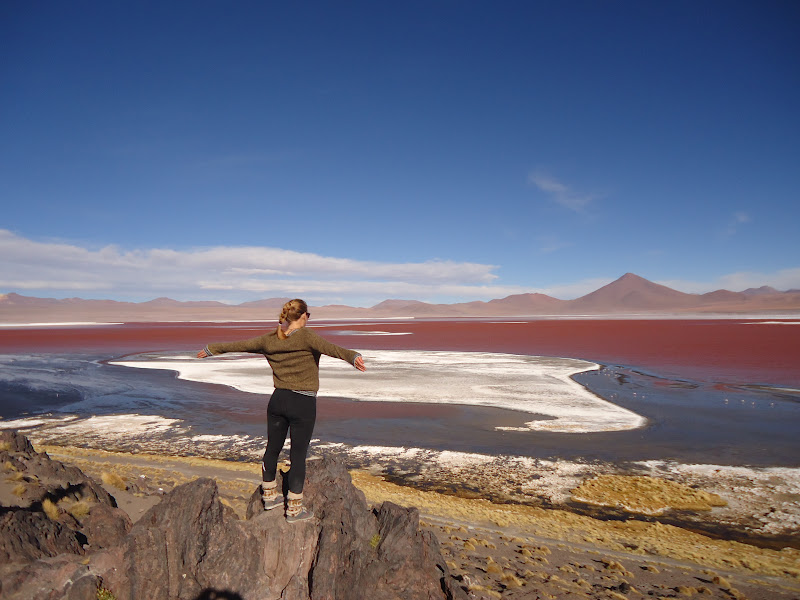
 Saturday we set off relatively early because we had a lot of driving to do. I think we drove for about five or six hours straight at one point. If the previous day's theme had been salt, this day it was all about lagoons. Well, to get to the lagoons we had to drive through deserts. Deserts, upon deserts, upon deserts. Laguna Colorada was the highlight of the day, possibly the highlight of the trip for me. This is what I was most looking forward to, and it exceeded all my expectations. It is this huge lagoon, with red water– there were also hues of purple. The lake is red from the algae and plankton– and it is also very shallow, only 20 inches deep at the greatest depth, I think this plays a huge role in the color.


Before reaching Laguna Colorada we went to three or four others– none of them quite as amazing but still beautiful. In the summer these lagoons are home to thousands of flamingos, but all but a few brave souls have migrate to Chile for the winter. We ate a very late lunch at one of the lagoons, and because it was around 2:00 there were no other tourists in sight so we had the whole lagoon and about a hundred flamingos to ourselves. But to be honest, it was so cold and windy that we all sat in the jeep and waited until lunch was ready.

We spent the second night in another small, unheated, salt hotel. Dinner that night was spaghetti with a bottle of wine to celebrate our last night together. Or I am assuming that is why Garcia gave us wine. Oh, I can't believe I didn't mention this in my last post: dinner the first night of the tour was llama! None of us knew what we were eating– we were all very confused about the chewy, white t-bone that we had been served. The next day I asked Garcia what it was, and he said llama. It was pretty good, just very tough meat!


Tuesday, May 29, 2012

No, I didn't go to Antarctica

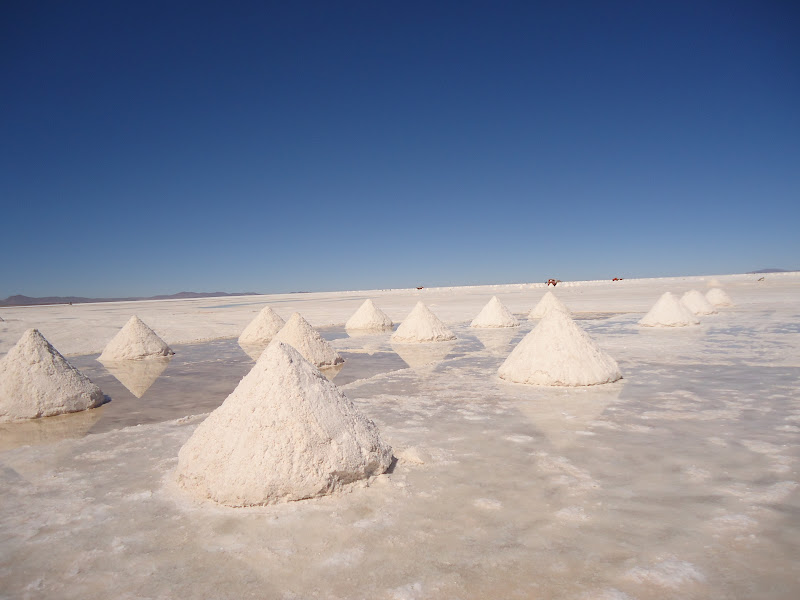
Pure salt. Not snow.
Salar de Uyuni is a massive salt flat in Southeast Bolivia. In fact, it is the largest salt flat in the world, at a whopping 12,603 square kilometers (4,000 plus square miles). And of course, it wouldn't be Bolivian unless I mentioned the altitude– the salt flat sits at 3653 meters. In Bolivia, everything is high. It is hard to believe that the salt flats were once underwater considering the high altitude, but it is the truth. 25,000-40,000 years ago this area was called Lake Minchin, but  it evaporated and voila– the salt flats! Actually, there were another couple lakes a few thousand years later and then they also evaporated and now we have the Salar de Uyuni leaving tons, literally tons, of salt deposits. An estimated 18,000-25,000 tons of salt is harvested every year– and the flats contain approximately 10 billion tons of salt! Beneath this salt crust is half the world's supply of lithium. 
The salt is piled like this so the water drains out, then it is
exported.
I went on a three day tour of the salt flats and the surrounding views– including a national park and it was absolutely incredible. I am now really aware and self conscious of the words I use to describe sights and attractions since there were two Germans on my tour that loved to mimic Americans. I couldn't say a place was beautiful without the two of them saying– "ohmygod, I love it! I have to call my mom!" Even though they would laugh right now if they read this and saw me using the word incredible to describe it, there is no other way to put it. The salt flats and the surrounding attractions are truly a masterpiece of nature.

So how this tour worked: I had a jeep, a driver, and five other tourists with me. I was so lucky to be in such a fun and energetic group. I think they actually made the experience so much better, regardless of who I was with the sights still would have been unbelievable, but I wouldn't necessarily have had as much fun as I did. We drove 1000 kilometers in three days– across the salt flats and deserts. Somehow, I got shotty the whole time so I had the best views. At night, we slept in frigid temperatures in get this.... salt hotels. Yes, hotels made of salt. Big blocks of salt. Our beds, made of salt (not the mattresses obviously). The tables, made of salt. Benches, made of salt. The floor, made of salt. The toilet... not made of salt. Somehow I failed to take a photo. Probably because my hands were too numb to hold a camera. It was so cold, supposedly it gets to -15 degrees Celcius at night but I don't think it was that cold. Luckily, our beds had three heavy wool blankets, plus a duvet, and our tour agency gave us sleeping bags. With my spandex, three sweaters, hat, gloves, and scarf I was set for the night. There is no heat, or electricity for that matter. The power only comes on for two hours from 7 to 9 during dinner.
I told you, giant cacti.

The first day we drove across the salt flats, stopping at Isla Incahauasi for lunch. This island is covered in giant cacti and coral (remnants from the salt-water lake). The island is surrounded by the salt flats– seeing the giant cacti in contrast with their blinding white surroundings was surreal. They just looked so out of place! When we were eating lunch we all agreed that the quinoa was lacking salt, so one of the Germans just wandered out to what appeared to be a clean and untouched patch of salt and brought some back to the table.

The salt flats are amazing places to take photos because they are so vast and endless– cameras lose all sense of depth. We took some funny group photos– but unfortunately they aren't on my camera. Hopefully at some point they will get emailed to me or I will get them off of facebook. I wish we had taken more photos, but our driver, Garcia, was always in a rush to get going to the next place. I guess that was the only disappointing part of my tour. Garcia wasn't a bad tour guide, he just wasn't good. He simply did his job. I feel like he almost viewed the tour as a race, he was trying to beat the other drivers to our final destination. He wasn't driving too fast– I always felt safe. But he definitely did not like to stop, and because of this I have way less photos than I would like. Well, guess I need to go to the salt flats again, but next time during the rainy season when there is a thin layer of water on the salt, producing a giant natural mirror. Bolivia in November, anyone?
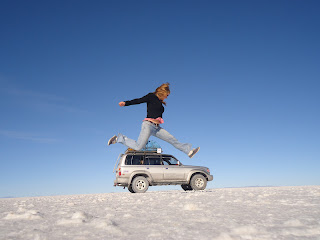
There were also llamas roaming around. They kept getting in
the way of all our photo shoots.

Tuesday, May 22, 2012

Juan y los frijoles mágicos

Today I started my project with the first, second, and third graders. I found Jack and the Beanstalk translated into Spanish and printed out the story in the form of a book and gave each student a page to illustrate. Next week I will bind all these pages together so their drawings become a real book that will be in the library. Then, comes part two of the project: students are all going to be growing their own bean plants in small containers. They all seem excited about the idea and I am too. For the older children we are going to be starting a school garden– this is a little harder to organize than a bean plant in a container. We are in the process of getting this all together, but it should be great. I also want to do some nutrition activities with them, teach them about the food pyramid, etc. Lots of ideas, not a lot of time!

Tomorrow night I am off for a long weekend trip– it is a holiday on Friday so there is no work on Thursday and Friday... I can live with that! So, until Sunday or Monday!


Ojo del Inca

As cool as Saturday was, Sunday was absolutely incredible, probably my favorite day in Bolivia
Laundry hanging up to dry, and in the
background people washing their clothes.
thus far. I went to Ojo del Inca, this amazing naturally heated lagoon on top of these beautiful hills. I had a lot of fun getting there. I went to a tour agency and asked how much it cost and they told me 80 Bolivianos, which I thought was way too much. So I found my own way by taking the local bus, which only cost 4 Bolivianos. I told the driver where I wanted to go, and after about thirty minutes he pulled over on the highway, pointed at me, and said Ojo del Inca. So, there I was, stranded on this Bolivian highway all by myself. I quickly saw that on the other side of the river there were a lot of people. So I wandered on over to find out that it wasn't Ojo del Inca, it was just a hot spring where people were doing their laundry– it was a Sunday after all. Laundry day!

I asked someone where Ojo del Inca was and he told me to walk uphill for a kilometer. I think he was lying, it was way more than a kilometer. Either that or I am just really out of shape. I walked up this dusty road surrounded by the most beautiful mountains. On second thought, maybe the reason why it took me so long to get there is because I stopped so many times to take photos and just appreciate the beauty around me. When I finally arrived at Ojo del Inca I was the only tourist there– awesome! This nice man named Freddy came over and explained the lagoon to me, and told me I should go swimming. Well, I had my bathing suit with me anyway so I thought, why not. Once I had changed he told me to dive in. Dive in from the shore. I said, I won't hit my head? He said no. So I took a leap of faith, or a dive a faith, and went head first into the water. I can't even explain that feeling of being suspended in the air for that split second before entering this amazing lagoon. It was incredible, I just felt so at peace. When I did hit the water I was shocked to feel how warm it was–86 degrees! And, I didn't hit the bottom. Diving from the shore into this lake, well it was quite amazing. I just swam around and relaxed taking in the amazing view around me. I was so happy at that moment. Sometimes, I just can't believe how beautiful this world is and how lucky I am to see and experience these amazing places. Besides the view, swimming in a naturally heated, almost perfectly circular lagoon was also incredible. It was so strange to swim in the warm water because the air around me was so cold. Whenever I lifted my arm out of the water I got goosebumps. Eventually, I made my way out, dried off, and continued to explore the area. There were a few more pools that were actually boiling hot. Literally.
A beautiful view
I started the slow, dusty descent back to the road where I waited until a bus going to Potosi rounded the corned and I waved it down. I left Potosi feeling very happy– all in all it was a great trip.

I read somewhere, or maybe someone told me, that in Bolivia the lower the elevation the nicer the people because they don't have to deal with the harsh conditions of a high altitude. In the case of Potosi, I can't think of anything more untrue. I found the locals so incredibly friendly and helpful. For example, when I got into Potosi at 8:30 at night (stupid to arrive in a strange city when it is completely dark out) someone from my bus helped me find my hotel. I had asked the woman sitting next to me if we were near the street where my hostel was and the man sitting in front overheard and said he lived nearby. This was one of those situations where I was like, okay should I trust this complete stranger. I made him show me exactly where we were on the map and then payed close attention to every turn we took, and eventually we wound up right at my hostel's front step. Mom, don't worry: it was well lit and there were people around me the whole time. If he led me down some dark alleyway I obviously wouldn't have followed. I find that one of the most difficult things about traveling: when to trust people and when to know when someone doesn't have the best intentions. This man clearly was just a very helpful person. He was so nice, we chatted the whole way. Then, when I was leaving Potosi I asked this couple walking down the street what letter micro goes to the bus station. They told me, and then waited at the bus stop with me until the micro came and I was onboard. Isn't that just so nice?! Gosh, I love Bolivians.